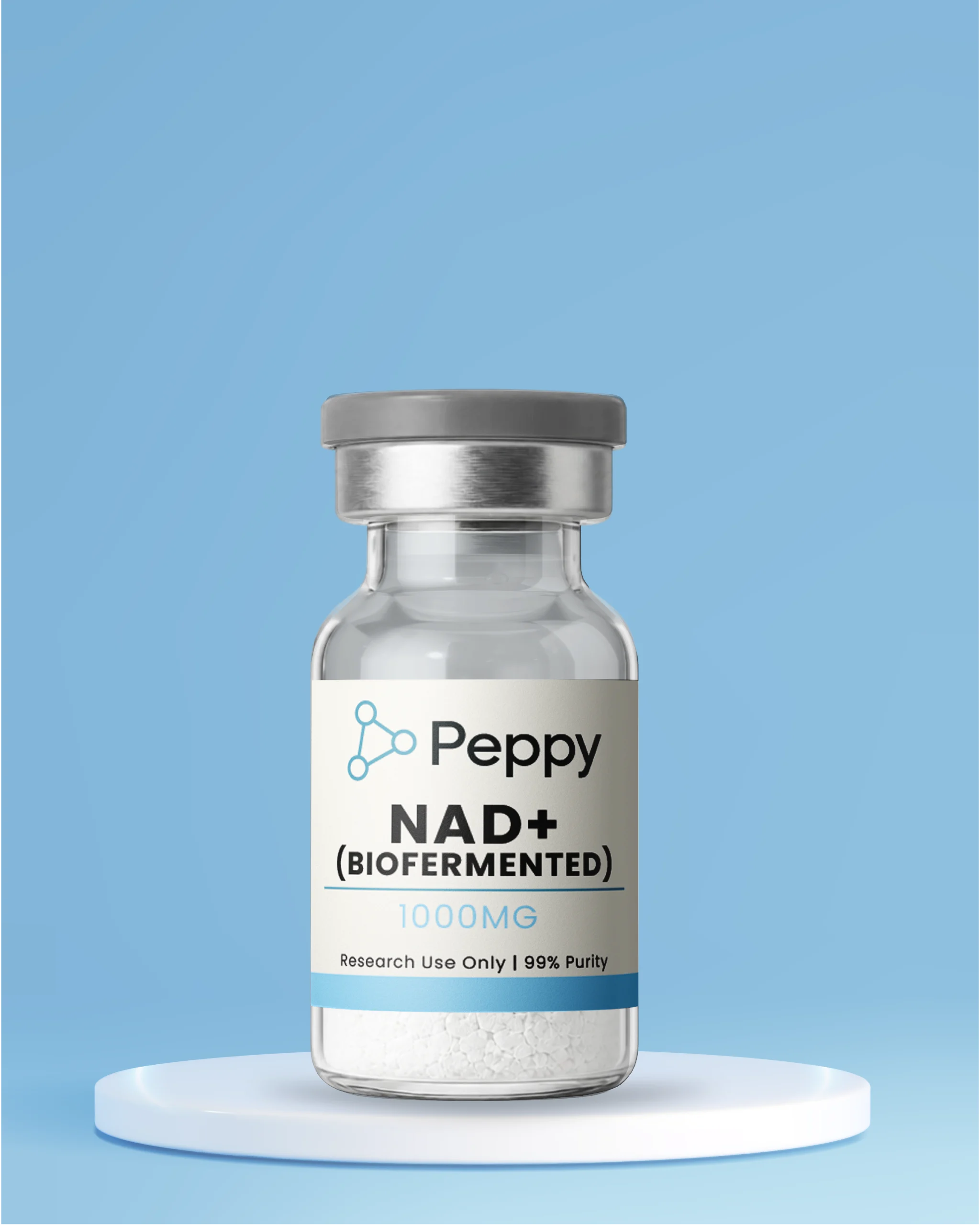
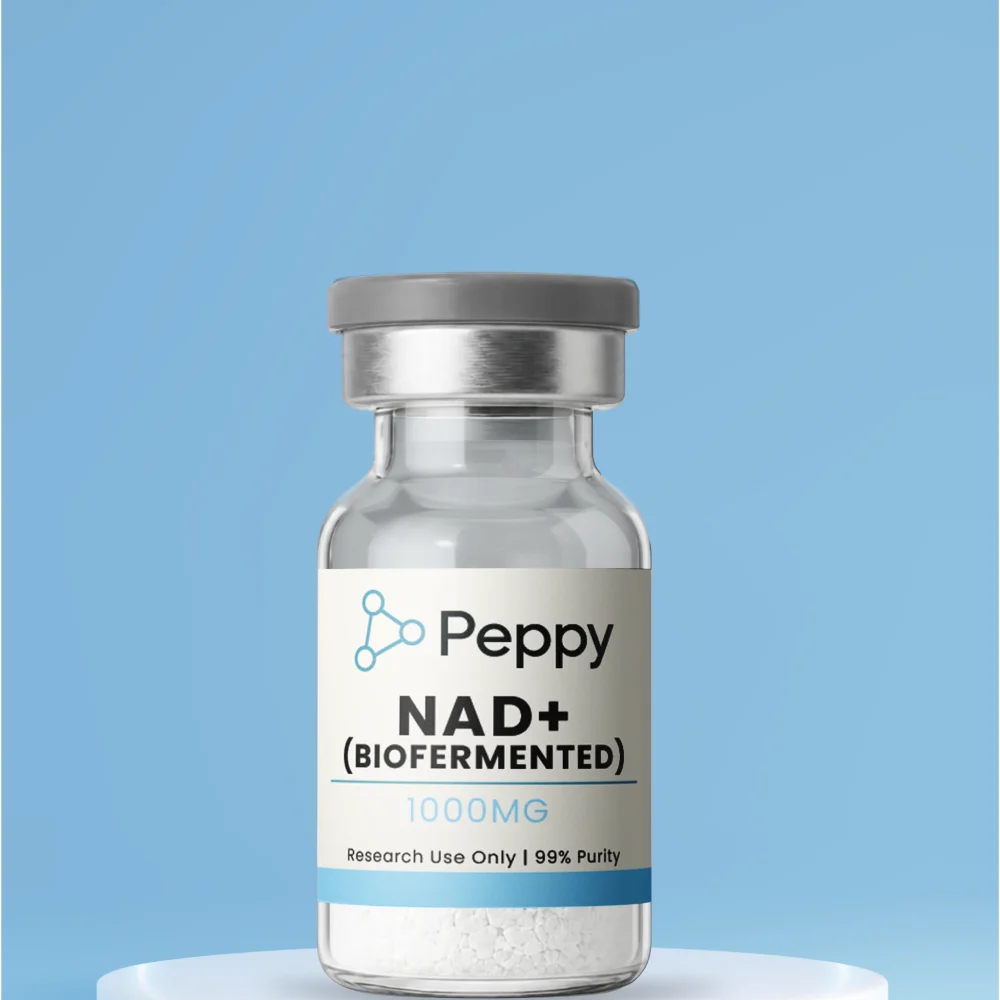
NAD+ – 1000mg BiofermentedCurrent
Lot NAD+072026MG
99.8%
Overall purity
Tested July 13, 2026
Open COAFOR LABORATORY RESEARCH PURPOSES ONLY. This compound has not received FDA approval. All information shown is drawn from published laboratory research for educational purposes
$175.00
Lost, stolen, or damaged? We replace it, on us.
Pick your speed at checkout.





Before you continue
This site sells research products exclusively to qualified researchers and laboratories for in vitro and laboratory use. Please confirm before continuing.
NAD+ (nicotinamide adenine dinucleotide) is a biofermented coenzyme found in all living cells, supplied here at 1000mg for laboratory research use only. NAD+ is studied in laboratory research for its role in mitochondrial function and in cellular pathways related to DNA repair.
NAD+ is a coenzyme present in every living cell, where it takes part in the fundamental redox reactions of cellular respiration. It exists in an oxidised form (NAD+) and a reduced form (NADH), and the two cycle continuously as part of core metabolic pathways.
Published research has explored how NAD+ interacts with sirtuin-associated signaling pathways and has examined its role as a substrate for PARP (poly-ADP-ribose polymerase) enzymes involved in DNA-repair pathways. NAD+ is also studied alongside NADP+, its phosphorylated derivative, which gives researchers a broader framework for comparative redox-pathway research.
NAD+ is widely studied in research on mitochondrial bioenergetics and cellular redox-signaling pathways, including its interaction with the mitochondrial electron-transport chain. In vitro models of DNA-repair mechanisms frequently include NAD+ to examine PARP-enzyme activity. Studies of sirtuin-associated pathways also use NAD+, because it is a required cofactor for sirtuin-enzyme activity.
NAD+ is also studied for its precursor and salvage-pathway metabolism. Comparative protocols frequently examine NAD+ alongside precursor compounds such as NMN and nicotinamide riboside to study differences in salvage-pathway conversion and downstream enzyme activity.
NAD+ is the oxidised form of the coenzyme and NADH is the reduced form. The two cycle continuously as part of the redox reactions of cellular respiration.
NMN and nicotinamide riboside are precursor compounds in NAD+ salvage-pathway metabolism. Laboratories often study them alongside NAD+ to compare how they are converted and what enzyme activity follows.
Published laboratory research on NAD+ is indexed on PubMed.
Related Research Compounds: CJC-1295 / Ipamorelin - 10mg / 10mg • BPC Wolverine + KPV – 10mg / 10mg / 10mg • Browse all Best Sellers research compounds
For research use only. Not for human consumption. Not evaluated by the FDA. Not intended to diagnose, treat, cure, or prevent any disease. This compound has not received FDA approval. All information shown is drawn from clinical studies for educational purposes.
Researcher favourites
Lab-verified quality
Each lot is analysed by Bioviridian before release. Below is the Certificate of Analysis for the most recent lot, as issued by the laboratory.
Overall purity
99.8%
RP-HPLC (214 nm)
View the signed COA (PDF)Check this certificate at bioviridians.com/coa-search.html with code COA7695.
Test results
5 of 5 conformHPLC retention time 1.998 min · Signed: Shane Straight, M.S., Principal Chemist, Bioviridian Inc.
Every lot keeps its own signed certificate. Lots are listed newest first.
Lot NAD+072026MG
99.8%
Overall purity
Tested July 13, 2026
Open COAEarlier lots will appear here as new Certificates of Analysis are published.
Compound details
Molecular profile
Storage requirements
Store lyophilised compound at −20°C for long-term stability. Avoid repeated freeze-thaw cycles, protect from prolonged light exposure.
Refrigerate at 2–8°C after reconstitution and use within 4–6 weeks. Label the reconstitution date.
Published literature
2 peer-reviewed publications indexed on PubMed. Listed for reference only; inclusion does not imply any use, effect or endorsement.
SCIENCE · 2015
NAD⁺ in aging, metabolism, and neurodegeneration
Verdin E Science. 2015;350(6265):1208-1213. doi:10.1126/science.aac4854
Reviewed NAD+ biosynthesis and consumption pathways and the role of NAD+-dependent enzymes such as sirtuins in metabolic and age-related processes.
NAT REV MOL CELL BIOL · 2021
NAD(+) metabolism and its roles in cellular processes during ageing
Covarrubias AJ, Perrone R, Grozio A, et al. Nat Rev Mol Cell Biol. 2021;22(2):119-141. doi:10.1038/s41580-020-00313-x
Reviewed NAD+ synthesis, salvage and consumption (including by CD38, PARPs and sirtuins) and how cellular NAD+ levels change with age in model systems.