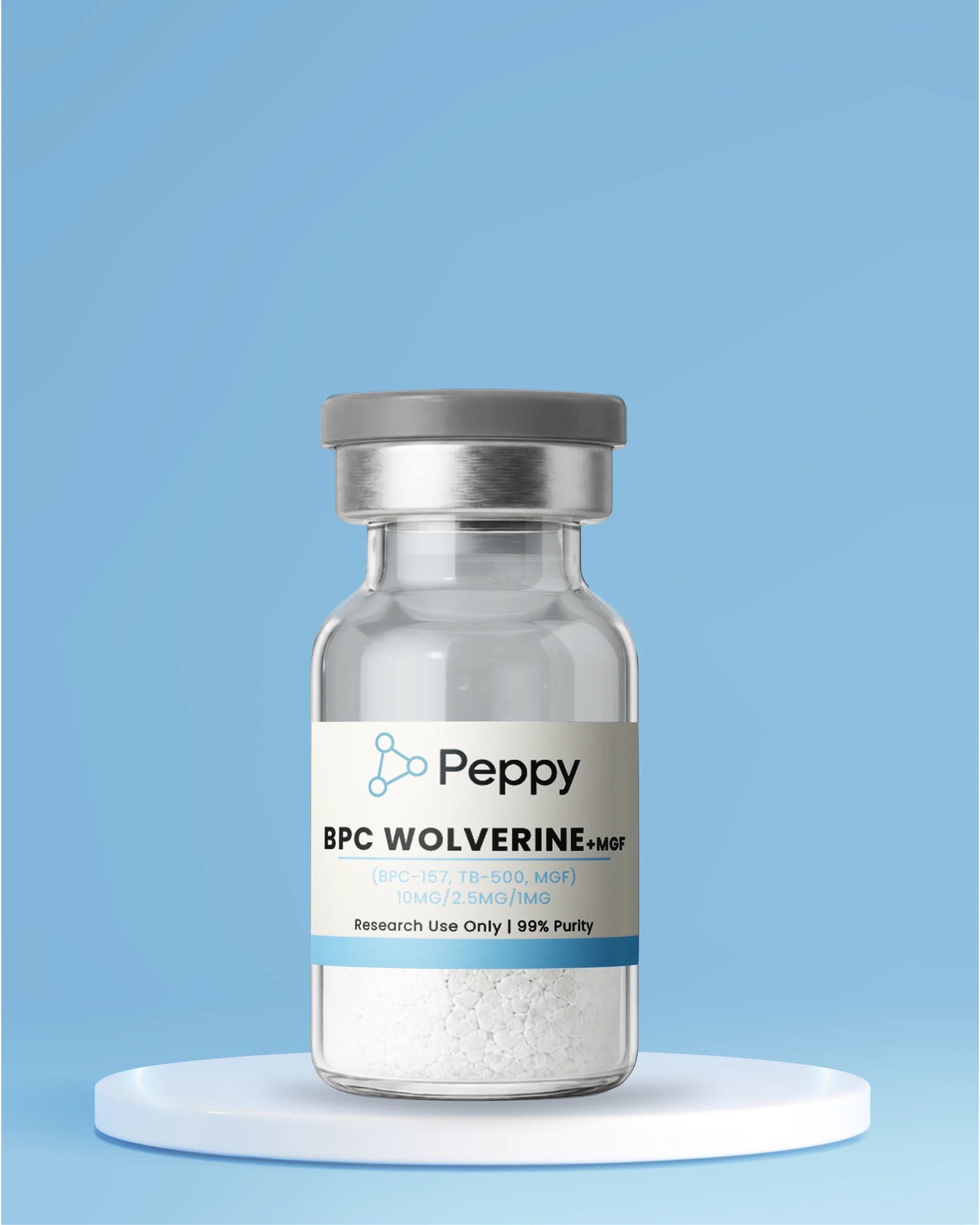
BPC Wolverine + MGF – 13.5mgCurrent
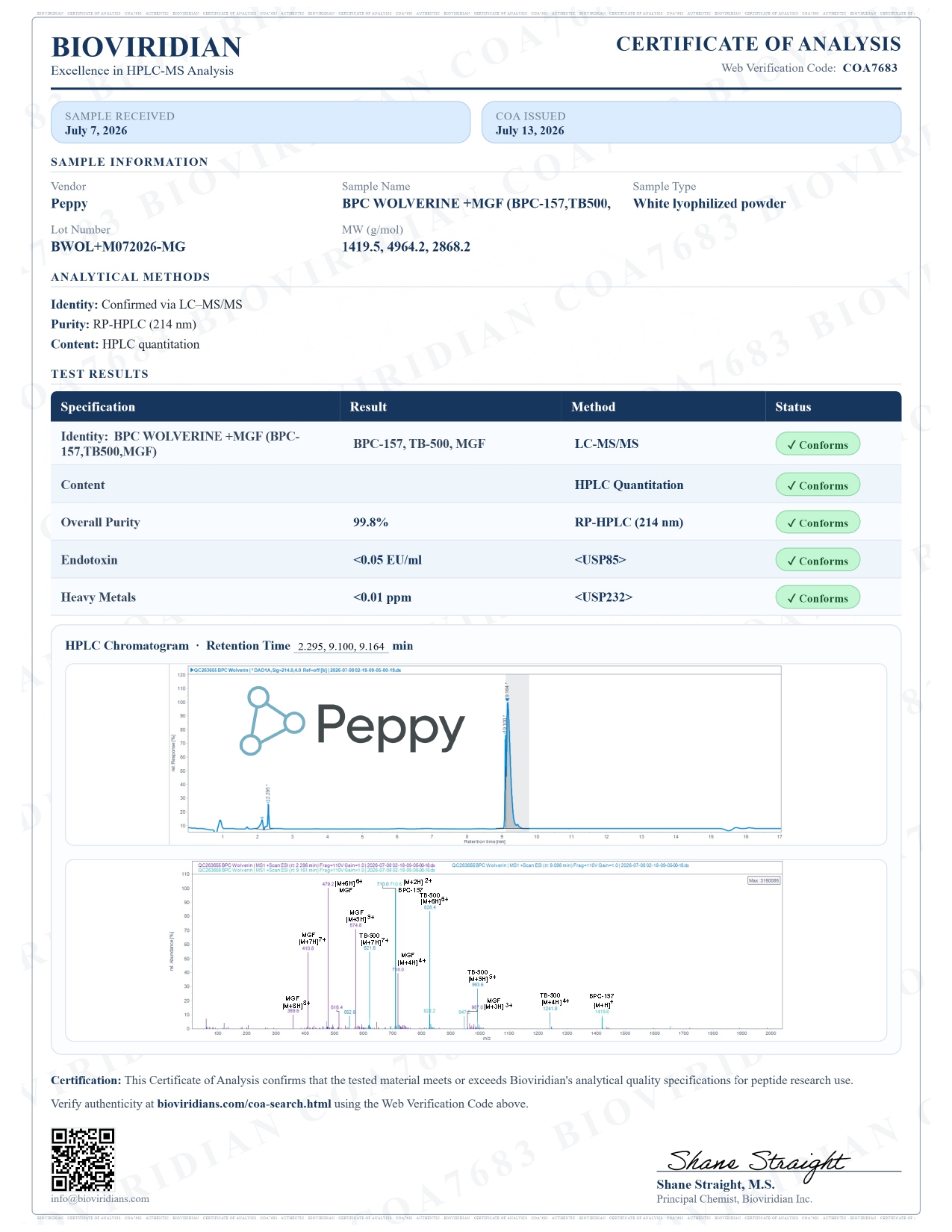
Lot BWOL+M072026-MG
99.8%
Overall purity
Tested July 13, 2026
Open COAFOR LABORATORY RESEARCH PURPOSES ONLY. This compound has not received FDA approval. All information shown is drawn from published laboratory research for educational purposes
$135.00
Lost, stolen, or damaged? We replace it, on us.
Pick your speed at checkout.





Before you continue
This site sells research products exclusively to qualified researchers and laboratories for in vitro and laboratory use. Please confirm before continuing.
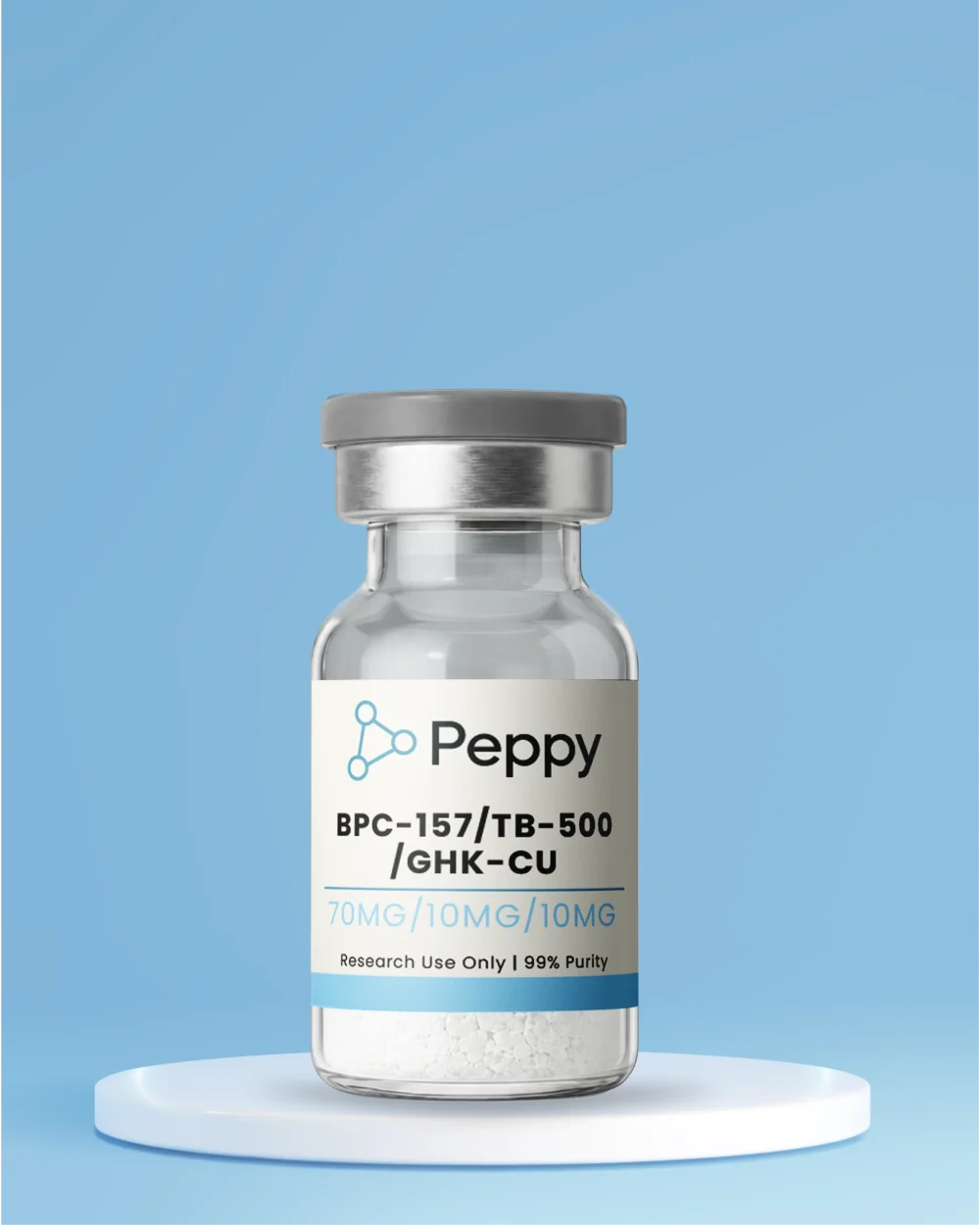
BPC Wolverine + MGF (13.5mg) is a research compound blend that combines BPC-157, TB-500 and MGF, supplied by Peppy Peptides for laboratory research use only. BPC Wolverine + MGF pairs peptides from distinct structural classes, each studied in laboratory research for its interaction with tissue-repair and cellular-signaling pathways.
BPC Wolverine + MGF combines three research peptides from different structural families:
Together, the three peptides give researchers one blend for studying the tissue-repair and cellular-signaling pathway families, instead of three separate single-compound vials.
Laboratory work involving BPC-157 frequently focuses on cellular-signaling pathways connected to tissue-level biological processes, using in-vitro and in-vivo research models. TB-500 is referenced in cytoskeletal and cell-migration research models for its actin-binding mechanism. MGF is examined in research on IGF-1-family signaling and cellular-repair pathways.
As a combined formulation, BPC Wolverine + MGF is used to study how these pathway families interact within a single research model. All applications described here refer only to laboratory and in-vitro/in-vivo model research.
BPC Wolverine + MGF combines BPC-157, TB-500 and MGF (mechano growth factor), a splice variant of IGF-1.
No. BPC Wolverine + MGF is supplied for laboratory research use only by qualified researchers working in a controlled laboratory setting.
Published laboratory research on BPC-157 and MGF is indexed on PubMed.
For research use only. Not for human consumption. Not evaluated by the FDA. Not intended to diagnose, treat, cure, or prevent any disease. This compound has not received FDA approval. All information shown is drawn from clinical studies for educational purposes.
Researcher favourites
Price range: $125.00 through $175.00
Price range: $150.00 through $650.00
Price range: $125.00 through $700.00
$150.00
$175.00
Lab-verified quality
Each lot is analysed by Bioviridian before release. Below is the Certificate of Analysis for the most recent lot, as issued by the laboratory.
Overall purity
99.8%
RP-HPLC (214 nm)
View the signed COA (PDF)Check this certificate at bioviridians.com/coa-search.html with code COA7683.
Test results
5 of 5 conformHPLC retention time 2.295, 9.100, 9.164 min · Signed: Shane Straight, M.S., Principal Chemist, Bioviridian Inc.
Every lot keeps its own signed certificate. Lots are listed newest first.
Lot BWOL+M072026-MG
99.8%
Overall purity
Tested July 13, 2026
Open COAEarlier lots will appear here as new Certificates of Analysis are published.
Compound details
Molecular profile
Storage requirements
Store lyophilized BPC Wolverine + MGF at −20°C for long-term stability, protected from light and moisture.
Once reconstituted, refrigerate at 2–8°C and use within 4–6 weeks; avoid repeated freeze-thaw cycles, keep the vial sealed between uses.
Published literature
8 peer-reviewed publications indexed on PubMed. Listed for reference only; inclusion does not imply any use, effect or endorsement.
CURR PHARM DES · 2014 BPC-157
Seiwerth S, Brcic L, Vuletic LB, et al. Curr Pharm Des. 2014;20(7):1121-5. doi:10.2174/13816128113199990421
Reviewed published laboratory and preclinical research on BPC 157 in relation to blood-vessel biology.
CURR PHARM DES · 2014 BPC-157
Stable gastric pentadecapeptide BPC 157-NO-system relation
Sikiric P, Seiwerth S, Rucman R, et al. Curr Pharm Des. 2014;20(7):1126-35. doi:10.2174/13816128113190990411
Reviewed research on the relationship between BPC 157 and the nitric oxide (NO) system.
NEURAL REGEN RES · 2022 BPC-157
Pentadecapeptide BPC 157 and the central nervous system
Vukojevic J, Milavić M, Perović D, et al. Neural Regen Res. 2022;17(3):482-487. doi:10.4103/1673-5374.320969
Reviewed preclinical research on BPC 157 in relation to the central nervous system.
THE JOURNAL OF BIOLOGICAL CHEMISTRY · 1991 TB-500 / Thymosin beta-4
Thymosin beta 4 and Fx, an actin-sequestering peptide, are indistinguishable
Safer D, Elzinga M, Nachmias VT The Journal of biological chemistry. 1991;266(7):4029-32.
Sequenced the platelet actin-sequestering peptide Fx, identified it as thymosin beta-4, and characterized its 1:1 binding to G-actin and inhibition of actin polymerization.
THE JOURNAL OF PHYSIOLOGY · 1999 MGF
McKoy G, Ashley W, Mander J, et al. The Journal of physiology. 1999;516 ( Pt 2)(Pt 2):583-92. doi:10.1111/j.1469-7793.1999.0583v.x
Measured expression of IGF-1 splice variants, including the stretch-responsive MGF isoform, and structural genes in rabbit skeletal muscle subjected to stretch and electrical stimulation.
FEBS LETTERS · 2002 MGF
Yang SY, Goldspink G FEBS letters. 2002;522(1-3):156-60. doi:10.1016/s0014-5793(02)02918-6
Compared the effects of a synthetic MGF E-domain peptide and mature IGF-I on proliferation and differentiation of C2C12 myoblasts, including IGF-I receptor blocking experiments.
THE JOURNAL OF PHYSIOLOGY · 2003 MGF
Hill M, Goldspink G The Journal of physiology. 2003;549(Pt 2):409-18. doi:10.1113/jphysiol.2002.035832
Measured the time course of IGF-I splice-variant (MGF and IGF-IEa) mRNA expression relative to satellite-cell activation markers in rat tibialis anterior muscle after mechanical or bupivacaine-induced damage.
PHYSIOLOGY (BETHESDA, MD.) · 2005 MGF
Mechanical signals, IGF-I gene splicing, and muscle adaptation
Goldspink G Physiology (Bethesda, Md.). 2005;20:232-8. doi:10.1152/physiol.00004.2005
Reviewed how mechanical signals regulate alternative splicing of the IGF-I gene and the proposed roles of the MGF splice variant in muscle tissue.