TesamorelinCurrent
Lot TESA072026-MG
99.8%
Overall purity
Tested July 13, 2026
Open COAFOR LABORATORY RESEARCH PURPOSES ONLY. This compound has not received FDA approval. All information shown is drawn from published laboratory research for educational purposes
Price range: $75.00 through $125.00
Lost, stolen, or damaged? We replace it, on us.
Pick your speed at checkout.





Before you continue
This site sells research products exclusively to qualified researchers and laboratories for in vitro and laboratory use. Please confirm before continuing.
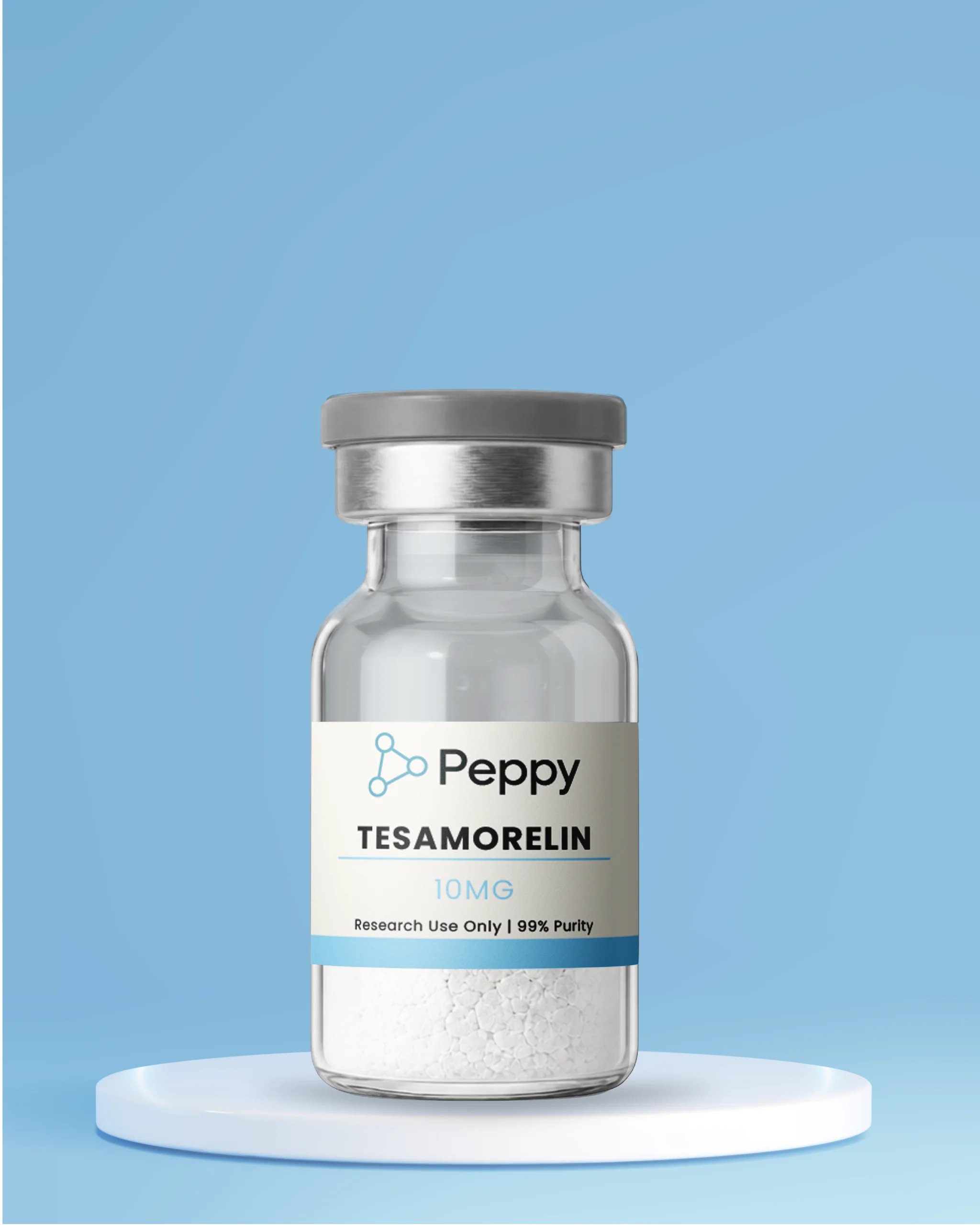
Tesamorelin is a synthetic analogue of growth-hormone-releasing hormone (GHRH), supplied by Peppy Peptides for laboratory research use only. It is a well-characterized compound for controlled endocrine-signaling research in cell-based and animal-model systems.
Native GHRH is a naturally occurring hypothalamic peptide. Tesamorelin is a modified 44-amino-acid GHRH analogue, engineered for greater stability in research settings than the rapidly degraded native peptide.
Because of this structural relationship, Tesamorelin is studied for its interaction with GHRH receptor pathways on pituitary somatotroph cells. Researchers examine how its stabilized structure affects receptor-binding kinetics compared with native GHRH, and it is referenced in the literature alongside other GHRH analogues used in structure-activity research.
Tesamorelin is referenced in laboratory literature examining GHRH receptor signaling, particularly in vitro models of pituitary somatotroph-cell response. It is also used in peptide-stability research, where its resistance to enzymatic degradation is compared with that of native GHRH in plasma-stability assays.
Endocrinology laboratories have used Tesamorelin as a reference compound in receptor-binding studies of GHRH-receptor affinity and downstream signaling cascades in cell-culture models. Published research has also examined its interaction with hypothalamic-pituitary axis signaling in animal-model systems, and it appears in structure-activity work comparing modified and native GHRH-family peptides.
Tesamorelin is studied for its interaction with GHRH receptor pathways, including pituitary somatotroph-cell signaling models and receptor-binding assays.
Tesamorelin is a modified 44-amino-acid GHRH analogue designed for greater stability than native GHRH. That makes it useful in research comparing how modified and native GHRH-family peptides resist enzymatic degradation and bind their receptor.
Published laboratory research on Tesamorelin is indexed on PubMed.
For research use only. Not for human consumption. Not evaluated by the FDA. Not intended to diagnose, treat, cure, or prevent any disease. This compound has not received FDA approval. All information shown is drawn from clinical studies for educational purposes.
Researcher favourites
Price range: $125.00 through $175.00
Price range: $150.00 through $650.00
Price range: $125.00 through $700.00
$150.00
$175.00
Lab-verified quality
Each lot is analysed by Bioviridian before release. Below is the Certificate of Analysis for the most recent lot, as issued by the laboratory.
Overall purity
99.8%
RP-HPLC (214 nm)
View the signed COA (PDF)Check this certificate at bioviridians.com/coa-search.html with code COA7702.
Test results
5 of 5 conformHPLC retention time 10.422 min · Signed: Shane Straight, M.S., Principal Chemist, Bioviridian Inc.
Every lot keeps its own signed certificate. Lots are listed newest first.
Lot TESA072026-MG
99.8%
Overall purity
Tested July 13, 2026
Open COAEarlier lots will appear here as new Certificates of Analysis are published.
Compound details
Molecular profile
Storage requirements
Supplied lyophilized; store at −20°C for long-term stability; avoid repeated freeze-thaw cycles
Refrigerate at 2–8°C after reconstitution; use within 4–6 weeks
Published literature
4 peer-reviewed publications indexed on PubMed. Listed for reference only; inclusion does not imply any use, effect or endorsement.
BASIC CLIN PHARMACOL TOXICOL · 2007
Ferdinandi ES, Brazeau P, High K, et al. Basic Clin Pharmacol Toxicol. 2007;100(1):49-58. doi:10.1111/j.1742-7843.2007.00008.x
Reported the non-clinical pharmacology, plasma stability and toxicology of TH9507 (trans-3-hexenoyl-hGRF(1-44)NH2) in rats, dogs and pigs.
INT J PHARM · 2004
Pulmonary delivery of TH9507, a growth hormone releasing factor analogue, in the dog
Jansen M, Darby I, Abribat T, et al. Int J Pharm. 2004;276(1-2):75-81. doi:10.1016/j.ijpharm.2004.02.012
Measured the pharmacokinetics and absorption of TH9507 after pulmonary, subcutaneous and intravenous administration in dogs.
NAT COMMUN · 2020
Structural basis for activation of the growth hormone-releasing hormone receptor
Zhou F, Zhang H, Cong Z, et al. Nat Commun. 2020;11(1):5205. doi:10.1038/s41467-020-18945-0
Determined the cryo-EM structure of the GHRH receptor bound to GHRH and the Gs protein to describe its activation mechanism.
DRUG TEST ANAL · 2021
Advances in the detection of growth hormone releasing hormone synthetic analogs
Memdouh S, Gavrilović I, Ng K, et al. Drug Test Anal. 2021;13(11-12):1871-1887. doi:10.1002/dta.3183
Reviewed analytical methods for detecting synthetic GHRH analogues, including tesamorelin and sermorelin, and their metabolites in biological samples.