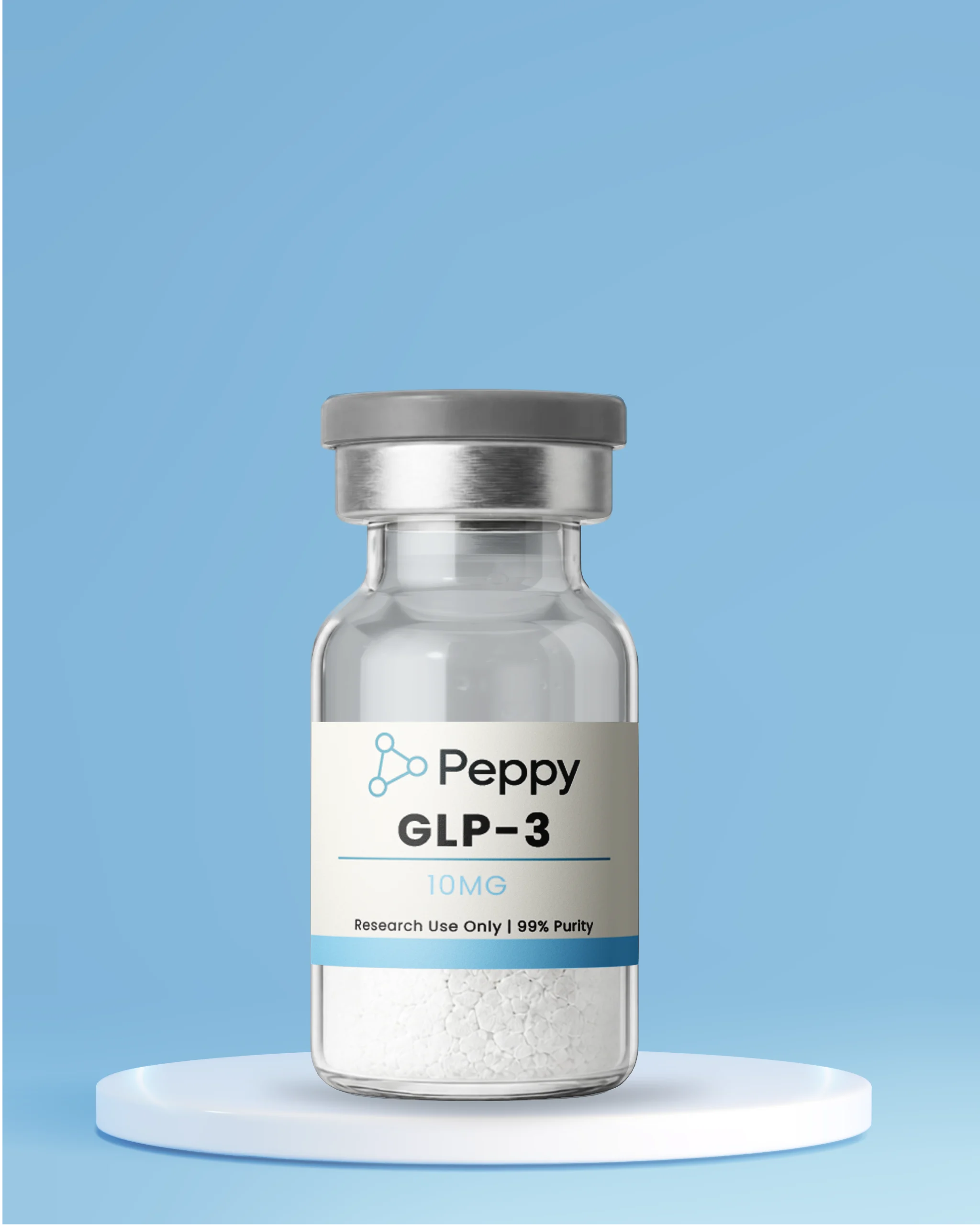
GLP-3

Lyophilized *MUST BE RECONSTITUTED* GLP-3 is a lab-developed tri-agonist that interacts with three receptor pathways: GLP-1, GIP, and glucagon. Researchers study compounds like this to better understand how multiple signaling pathways can be engaged at the same time within controlled laboratory environments. This multi-receptor approach is explored in research focused on complex biological signaling systems. GLP-3 is intended for research use only.

Price range: $450.00 through $700.00

GLP-3 is a synthetic peptide supplied by Peppy Peptides for laboratory research use only. Manufactured at 99% purity and verified through independent third-party testing, this research compound is provided strictly for qualified researchers and laboratories investigating GLP-1, GIP, and glucagon receptor signaling pathways, not for human or animal use.

What is GLP-3?

GLP-3 is a synthetic peptide designed to interact with multiple members of the incretin-receptor family, formulated as a research compound rather than a finished pharmaceutical product. In laboratory settings, GLP-3 is studied for its interaction with GLP-1, GIP, and glucagon receptor signaling pathways — a combination sometimes referred to in the literature as multi-receptor or “triple-agonist” incretin research. Researchers working with GLP-3 in vitro and in preclinical models examine comparative receptor-binding affinity across these three class B G-protein-coupled receptors, cross-receptor signal transduction, and how the peptide’s sequence design influences selectivity. Peppy Peptides supplies GLP-3 exclusively as a research formulation, manufactured to a consistent, high-purity standard so laboratories can rely on batch-to-batch reproducibility when designing multi-receptor signaling studies. Every unit is intended solely for licensed laboratory and research-institution use, not for consumption of any kind.

Research Applications

GLP-3 is commonly referenced in published laboratory research examining multi-receptor incretin pharmacology, comparative receptor-binding assays, and cross-pathway signal transduction. Researchers studying G-protein-coupled receptor activation frequently use GLP-3 as a reference compound when characterizing how a single peptide sequence engages GLP-1, GIP, and glucagon receptors simultaneously in vitro. The compound also appears in laboratory literature exploring structure-activity relationships among multi-target incretin analogs and assay-validation work comparing single- versus multi-receptor peptide designs. Because GLP-3 signaling spans several receptor families at once, laboratories working in cell-biology, biochemistry, and comparative-pharmacology research contexts may study GLP-3 as part of multi-receptor pathway characterization. All such research use is confined to qualified laboratory settings operating under controlled research protocols.

Purity & Third-Party Testing

Peppy Peptides GLP-3 is supplied at 99% purity, independently verified through HPLC (high-performance liquid chromatography) and mass spectrometry analysis. Every production batch is tested by a third-party laboratory, and a Certificate of Analysis documenting these results is available at peppyshop.com/certificate-of-analysis/, allowing researchers to confirm identity and purity before use in any laboratory protocol.

Storage & Handling

Store lyophilized GLP-3 at −20°C for long-term stability. Once reconstituted, refrigerate at 2–8°C and use within 4–6 weeks. Avoid repeated freeze-thaw cycles and protect the compound from light and moisture to preserve integrity between research sessions.

Frequently Asked Questions

What purity is Peppy Peptides GLP-3?

Peppy Peptides GLP-3 is supplied at 99% purity, verified by independent third-party HPLC testing and mass spectrometry. A Certificate of Analysis is available for every batch at peppyshop.com/certificate-of-analysis/.

How should GLP-3 be stored?

Store lyophilized compound at −20°C for long-term stability. Refrigerate at 2–8°C after reconstitution and use within 4–6 weeks.

What is GLP-3 studied for in laboratory research?

GLP-3 is studied in laboratory research for its interaction with GLP-1, GIP, and glucagon receptor signaling pathways.

Published laboratory research on GLP-3 is indexed on PubMed.

For research use only. Not for human consumption. Not evaluated by the FDA. Not intended to diagnose, treat, cure, or prevent any disease.