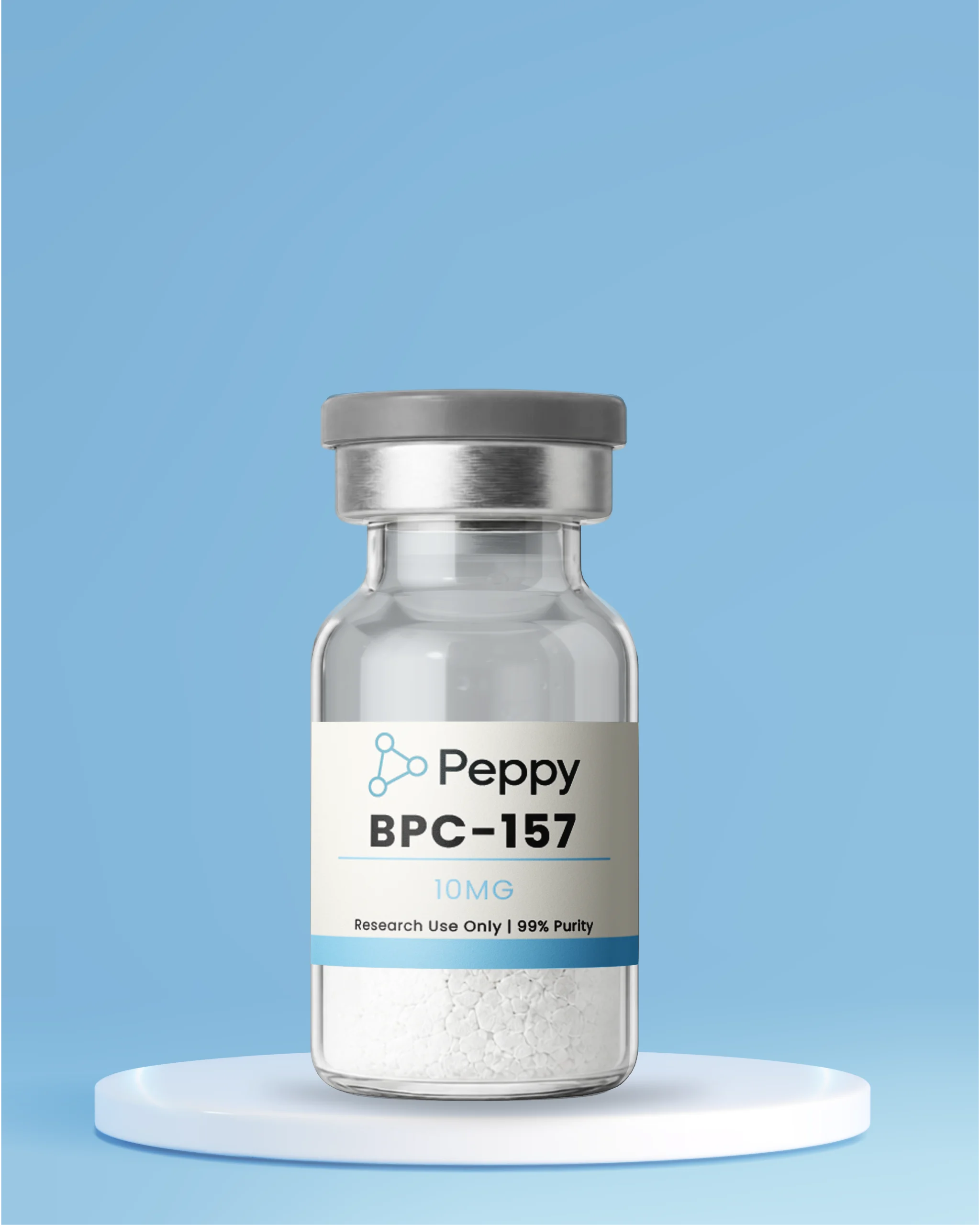
BPC-157 – 10mgCurrent
Lot BPC072026-MG
99.8%
Overall purity
Tested July 13, 2026
Open COAFOR LABORATORY RESEARCH PURPOSES ONLY. This compound has not received FDA approval. All information shown is drawn from published laboratory research for educational purposes
$50.00
Lost, stolen, or damaged? We replace it, on us.
Pick your speed at checkout.





Before you continue
This site sells research products exclusively to qualified researchers and laboratories for in vitro and laboratory use. Please confirm before continuing.
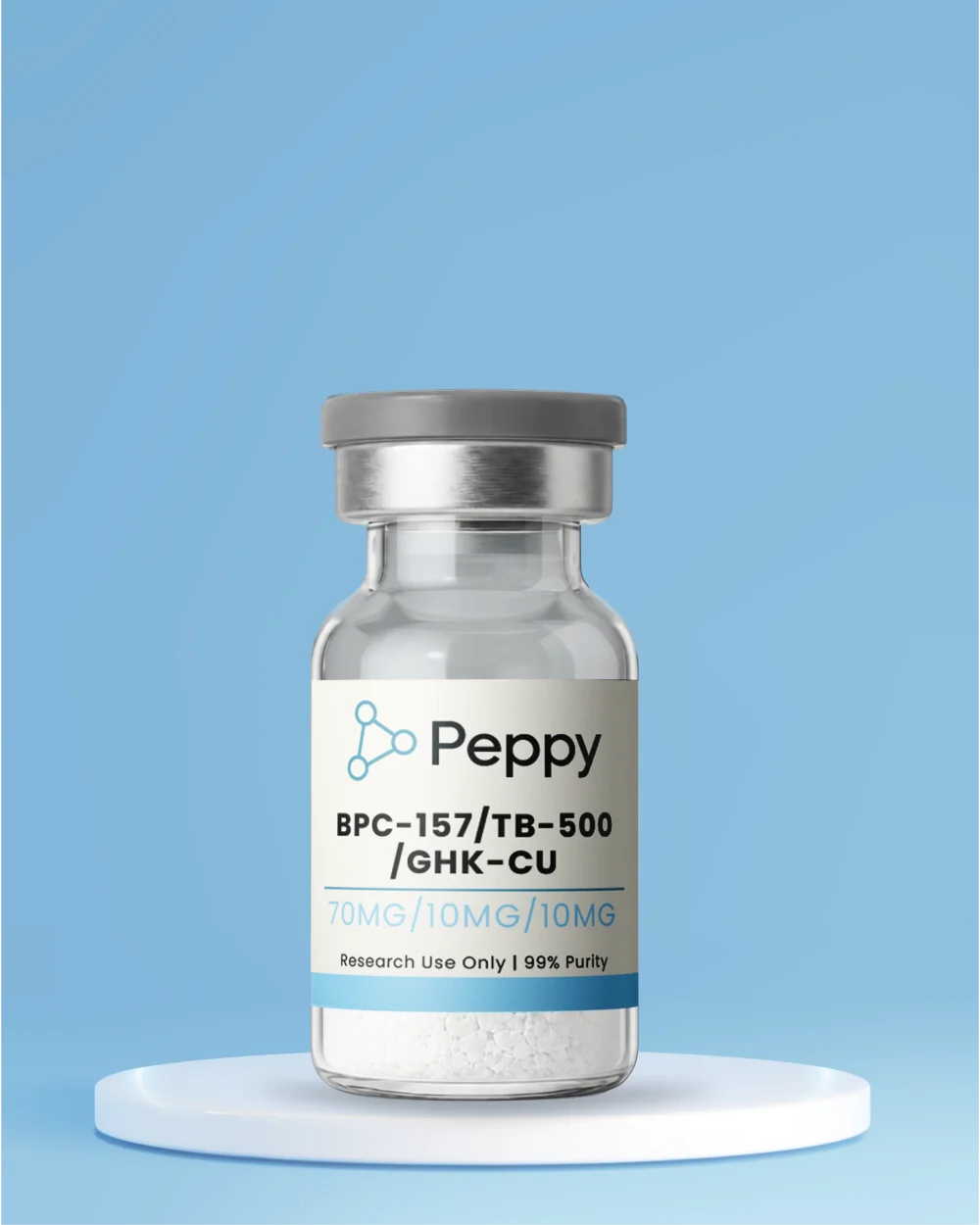
BPC-157 is a synthetic peptide derived from a naturally occurring body-protection compound originally identified in gastric juice. It is supplied by Peppy Peptides for laboratory research use only and is referenced frequently in tissue-repair signaling literature.
BPC-157 (Body Protection Compound-157) belongs to a class of partial peptide fragments studied for their stability and for their interaction with cellular-signaling receptors. Laboratory research has explored the interaction of BPC-157 with tissue-repair and inflammatory-signaling pathways. This includes pathways associated with angiogenesis-related signaling and cellular-repair mechanisms across a range of in-vitro and in-vivo research models.
BPC-157 (10mg) is supplied only to qualified researchers and laboratory personnel working in controlled research environments.
BPC-157 is frequently referenced in tissue-repair laboratory literature. Researchers commonly study it in:
Investigators also use BPC-157 in comparative peptide-stability studies and in research examining receptor-interaction pathways associated with tissue architecture. BPC-157 remains a frequently cited reference compound in cellular-pathway research design.
BPC-157 is a synthetic peptide derived from a naturally occurring body-protection compound in gastric juice. It is studied in laboratory research for its interaction with tissue-repair and inflammatory-signaling pathways.
BPC stands for Body Protection Compound, a name that reflects the gastric protein from which the peptide was originally derived.
Published laboratory research on BPC-157 is indexed on PubMed.
For research use only. Not for human consumption. Not evaluated by the FDA. Not intended to diagnose, treat, cure, or prevent any disease. This compound has not received FDA approval. All information shown is drawn from clinical studies for educational purposes.
Researcher favourites
Price range: $125.00 through $175.00
Price range: $150.00 through $650.00
Price range: $125.00 through $700.00
$150.00
$175.00
Lab-verified quality
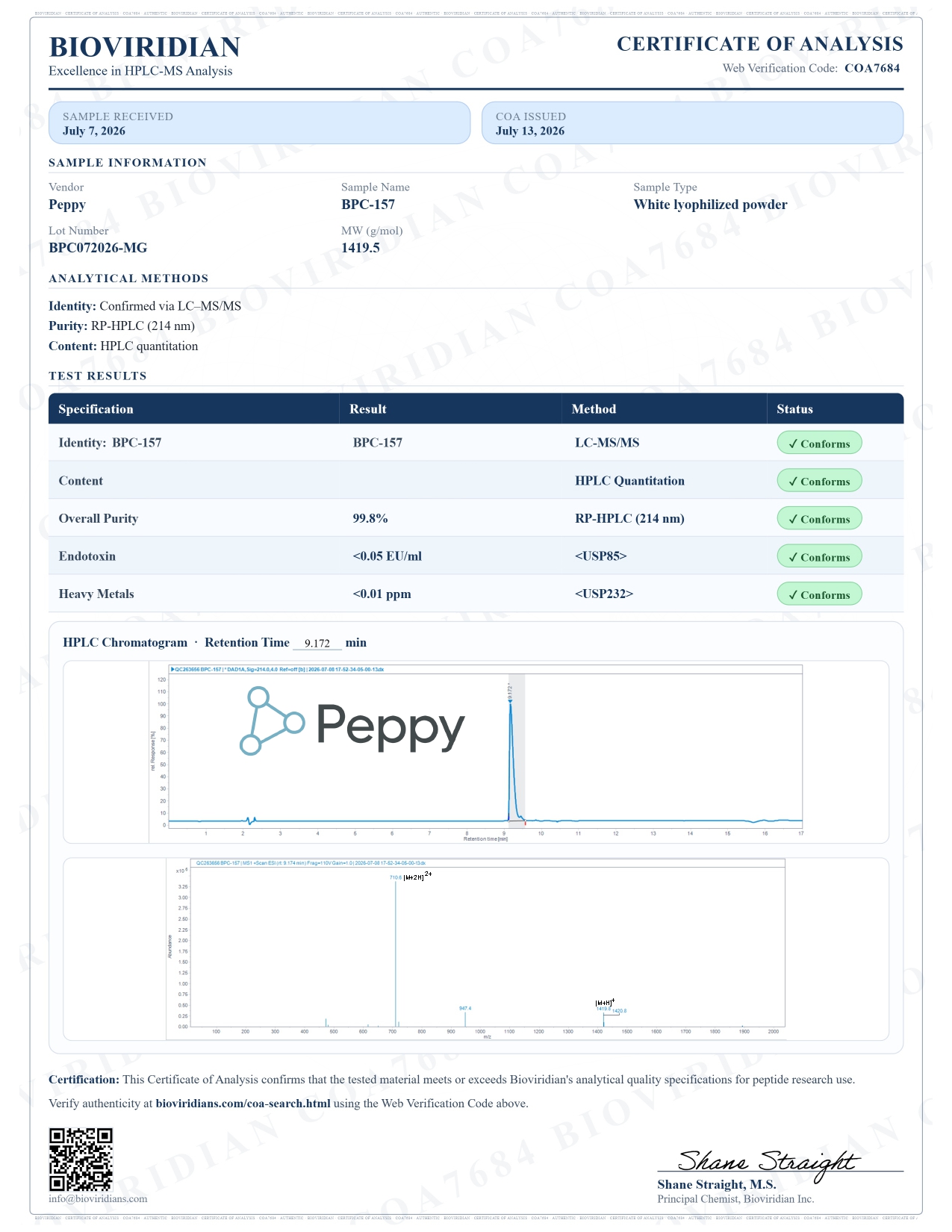
Each lot is analysed by Bioviridian before release. Below is the Certificate of Analysis for the most recent lot, as issued by the laboratory.
Overall purity
99.8%
RP-HPLC (214 nm)
View the signed COA (PDF)Check this certificate at bioviridians.com/coa-search.html with code COA7684.
Test results
5 of 5 conformHPLC retention time 9.172 min · Signed: Shane Straight, M.S., Principal Chemist, Bioviridian Inc.
Every lot keeps its own signed certificate. Lots are listed newest first.
Lot BPC072026-MG
99.8%
Overall purity
Tested July 13, 2026
Open COAEarlier lots will appear here as new Certificates of Analysis are published.
Compound details
Molecular profile
Storage requirements
Store lyophilized BPC-157 at −20°C for long-term stability.
Once reconstituted, refrigerate at 2–8°C and use within 4–6 weeks; avoid repeated freeze-thaw cycles.
Published literature
3 peer-reviewed publications indexed on PubMed. Listed for reference only; inclusion does not imply any use, effect or endorsement.
CURR PHARM DES · 2014
Seiwerth S, Brcic L, Vuletic LB, et al. Curr Pharm Des. 2014;20(7):1121-5. doi:10.2174/13816128113199990421
Reviewed published laboratory and preclinical research on BPC 157 in relation to blood-vessel biology.
CURR PHARM DES · 2014
Stable gastric pentadecapeptide BPC 157-NO-system relation
Sikiric P, Seiwerth S, Rucman R, et al. Curr Pharm Des. 2014;20(7):1126-35. doi:10.2174/13816128113190990411
Reviewed research on the relationship between BPC 157 and the nitric oxide (NO) system.
NEURAL REGEN RES · 2022
Pentadecapeptide BPC 157 and the central nervous system
Vukojevic J, Milavić M, Perović D, et al. Neural Regen Res. 2022;17(3):482-487. doi:10.4103/1673-5374.320969
Reviewed preclinical research on BPC 157 in relation to the central nervous system.